
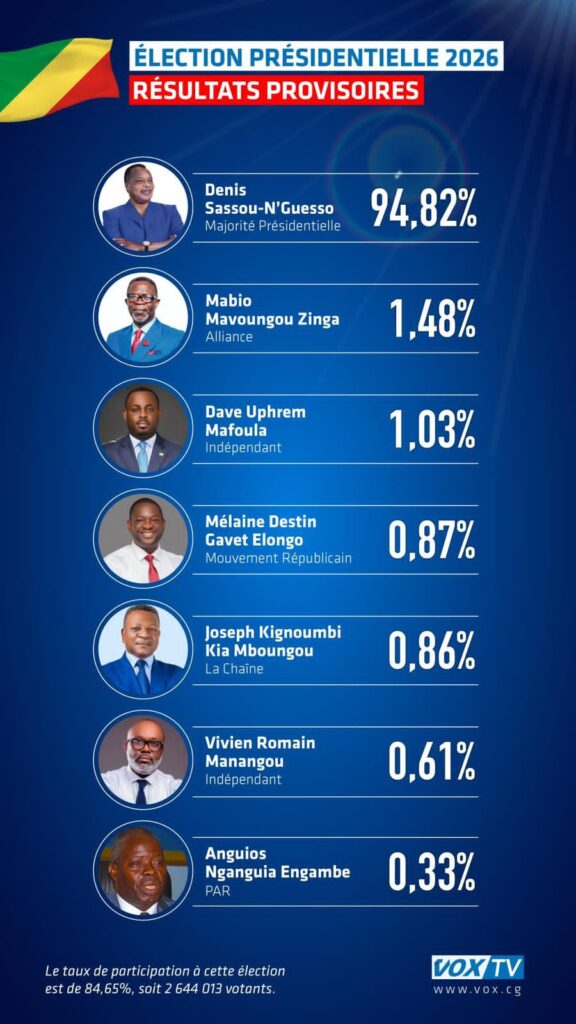
In the presidential election held in Republic of the Congo, provisional results claim that longtime ruler Denis Sassou-N’Guesso received 94.82 percent of the vote. The result would give the president yet another term after decades in power, reinforcing criticism that elections in the country function more as a ritual than a competition.
According to the announced figures, the remaining candidates together barely reached five percent. Mabio Mavoungou Zinga reportedly obtained 1.48 percent, while Dave Uphrem Mafoula received 1.03 percent. Mélaine Destin Gavet Elongo was credited with 0.87 percent, Joseph Kignoumbi Kia Mboungou with 0.86 percent, Vivien Romain Manangou with 0.61 percent, and Anguios Nganguiа Engambe with 0.33 percent.
Official figures claim voter turnout exceeded 84 percent. Yet many Congolese say participation on the ground was far lower. Conversations with residents and reports circulating locally suggest that many people simply did not bother voting because they believe the outcome of elections in the country is predetermined.
For some voters, abstention is a form of resignation rather than protest. The sentiment repeated by many citizens is that voting does not change anything. The result, they say, is already known before ballots are cast.
Others express a different form of acceptance. Some say they support the result or at least tolerate it because they fear instability if power changes hands. In a country marked by political conflict in the past, peace has become a powerful political message.
President Sassou-N’Guesso frequently frames his leadership around stability and peace. Critics argue that this rhetoric carries an implicit warning to voters that political change could bring unrest or even war. Supporters see it differently and credit him with maintaining order.
The election period was also marked by tight security measures and restrictions on political activity. Reports from civil society groups indicate that several activists were arrested, while public gatherings and demonstrations were prohibited in the days surrounding the vote.
Authorities also imposed internet disruptions and blackouts, a tactic frequently used during sensitive political moments in several countries to limit communication and the spread of information. Critics argue that such measures make independent monitoring and reporting more difficult.
After decades in power, the latest election once again raises the same question voiced by many Congolese observers: whether elections in the country still represent a genuine democratic process, or simply another confirmation of a presidency that appears permanent.