
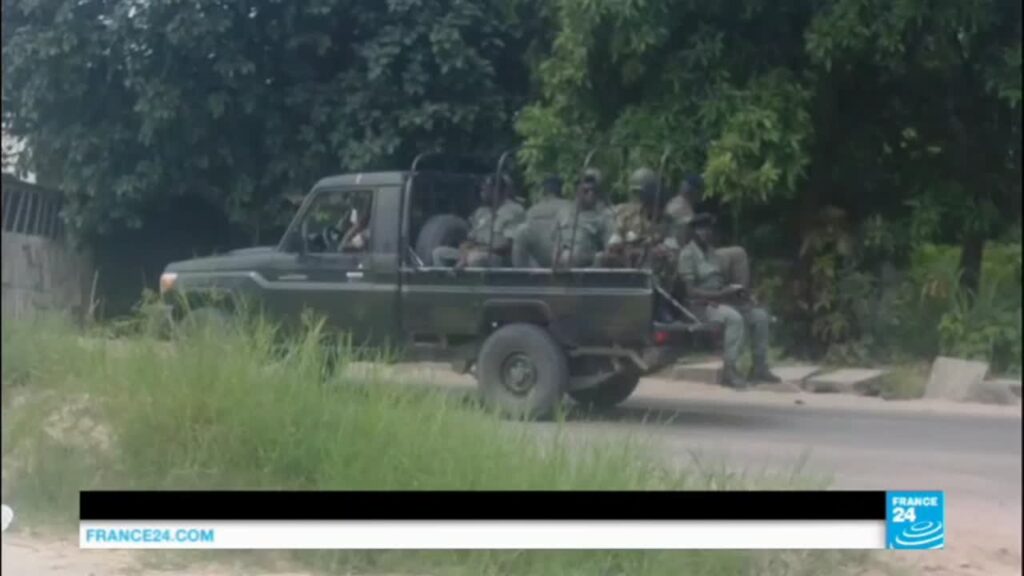
The violent incident reported in Mandu village, in the Pool department, raises serious questions about the role of state security forces in the production, rather than the prevention, of instability in the Republic of Congo. Presented officially as a security intervention, the DGSP operation has instead degenerated into armed confrontation, property destruction, and civilian casualties.
According to local reports, DGSP units entered Mandu, after which several motorcycles were set on fire. The incident triggered a standoff when residents immobilized a DGSP vehicle and demanded compensation before its release. Gunfire followed, and armed exchanges reportedly continue between security forces and local groups.
This sequence of events fits a familiar pattern. Security operations framed as preventive or protective have, in practice, repeatedly resulted in lethal force against individuals later described as suspects, accomplices, or hostile elements. These categories are so elastic that they often collapse into mere perceptions rather than evidence. In such contexts, killings are retroactively justified under the language of order and national security.
The broader political context makes this episode especially significant. Congo-Brazzaville is scheduled to hold a presidential election in the first quarter of this year. Historically, periods preceding elections have coincided with heightened security activity, particularly in politically sensitive regions. Insecurity has functioned not only as a justification for exceptional measures but also as a mechanism for managing political competition.
The Pool department occupies a strategic position within this logic. It is associated with opposition politics and remains symbolically linked to Pastor Ntumi, a longstanding political adversary of the regime. Renewed instability in this area is therefore unlikely to be politically neutral. Whether intentional or opportunistic, the outbreak of violence provides a plausible pretext to invoke security concerns that could delay electoral timelines or restrict participation under the guise of public safety.
What is notable is that the current unrest does not appear to emerge from spontaneous communal conflict but from a security intervention itself. When state forces ignite confrontation and then cite the resulting disorder as evidence of insecurity, the distinction between cause and response collapses. Violence becomes both the trigger and the justification.
In this sense, the events in Mandu point less to a breakdown of state authority than to its strategic deployment. Insecurity, once manufactured, can be administratively useful. It enables exceptional governance, limits political mobilization, and reframes dissent as a security threat rather than a political position.
Whether this episode remains localized or evolves into a broader conflict will depend less on local dynamics than on national political calculations. As the electoral calendar advances, the management of insecurity may prove as consequential as the vote itself.