
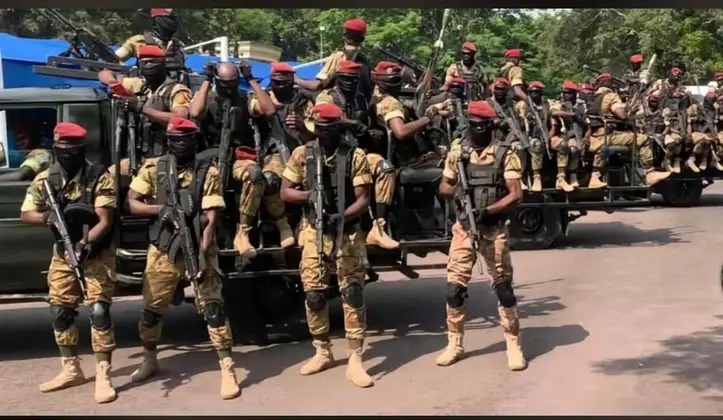
Brazzaville is bleeding in silence. Since late September, the Congolese capital has witnessed a chilling wave of state-sanctioned violence—young men executed in broad daylight, bodies left in the street, and neighborhoods terrorized under the guise of “security operations.” The culprits are not gangs, but the Direction Générale de la Sécurité Présidentielle (DGSP)—an elite military unit reporting directly to President Denis Sassou Nguesso, who has ruled the Republic of Congo for nearly four decades.
Videos circulating on TikTok and WhatsApp tell a grim story: armed men in balaclavas dragging youths into the open, forcing them to the ground, and shooting them at point-blank range. “Ils lui ont mis une balle dans la tête,” recounts a horrified witness— “they put a bullet in his head.” These executions are being carried out against alleged gang members known as “bébés noirs” or “kulunas.”
The government claims it is fighting crime. But the scenes unfolding in Brazzaville suggest something far darker—a purge masquerading as justice.
A Campaign of Fear
The bébés noirs are mostly young, unemployed men from working-class neighborhoods. Many are accused of petty crimes or simply profiled based on their appearance — dreadlocks, tattoos, or baggy clothes are now enough to mark someone for death.
A witness identified as “Michel” described one such killing:
“They stopped in front of a house, dragged a young man into the street, and shot him in the head. The body was left there. They forbid families from mourning . It’s meant to send a message.”
That message is clear: dissent and disorder will be met with bullets.
Residents describe a city paralyzed by fear. Streets empty out by 10 p.m. The DGSP’s armored vehicles roam as if in a war zone. Families whisper about disappearances. Homes are demolished without explanation. Even mourning the dead has become a forbidden act.
Executions Without Trial
Human rights organizations are sounding the alarm.
“These are extrajudicial executions,” says Nina Cynthia Kiyindou Yombo, director of the Observatoire Congolais des Droits de l’Homme. “People are being killed without trial, without investigation, on the basis of anonymous denunciations. It’s state violence, pure and simple.”
The government, however, remains silent. Official statements are nonexistent, and requests for comment go unanswered. Instead, residents receive SMS messages urging them to “report kulunas”—with rewards promised for information. A grim irony: a state that cannot provide jobs now pays citizens to betray one another.
The President’s Hidden Agenda
This brutal campaign unfolds just months before Congo’s 2026 presidential election, where Denis Sassou Nguesso is widely expected to seek a fifth term. Critics argue that the crackdown on bébés noirs serves a political purpose: to project control, crush potential unrest, and remind a weary nation who holds the monopoly on violence.
For decades, Sassou Nguesso has governed through a blend of patronage and repression. His regime presents itself as a bulwark against chaos—a message now weaponized through fear. One government insider even justified the killings by comparing Congo to Haiti:
“When the higher interest of the nation is at stake, a responsible government takes radical measures. The Congo does not want to become Haiti.”
But the comparison is hollow. The threat to Congo’s stability does not come from its disillusioned youth—it comes from a political system that has left them jobless, voiceless, and expendable.
A Nation Without Witness
At the heart of this tragedy lies a silence—enforced not just through censorship, but through terror. Journalists avoid the story. Families bury their sons in secret. Entire communities live under siege.
The DGSP, created to protect the president, has turned its weapons inward, transforming public safety into public terror. Each killing sends a message that law and life itself bend to the will of one man.
As the 2026 election approaches, the images from Brazzaville serve as both warning and prophecy: a state that murders its children to preserve its leader’s power is not fighting crime- it is erasing its future.
Denis Sassou Nguesso’s government may claim it wants to prevent Congo from becoming Haiti. But the real danger is that it becomes something worse: a country where the line between the protector and the predator has been blurred.