
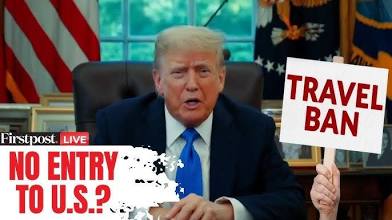
U.S. President Donald J. Trump has signed a new presidential proclamation expanding and reinforcing restrictions on entry into the United States for nationals of dozens of countries, citing national security, counterterrorism concerns, and the need to protect the integrity of the U.S. immigration system. The measure is scheduled to take effect on January 1, 2026, at 12:01 a.m. Eastern Time.
The action builds on Proclamation 10949 issued on June 4, 2025, and Executive Order 14161 signed on January 20, 2025, which reinstated and expanded migration controls reminiscent of policies implemented during Trump’s first term—policies that were ultimately upheld by the U.S. Supreme Court.
Security and vetting at the center of the policy
According to the White House, the proclamation aims to prevent the entry of foreign nationals who may pose risks related to terrorism, transnational crime, public safety, or abuse of the U.S. visa system. U.S. authorities argue that several governments lack reliable mechanisms for identity verification, criminal background checks, and information sharing with American agencies.
In many of the affected countries, U.S. officials say civil documentation systems are weak or compromised, with passports, birth certificates, and criminal records either unreliable or easily falsified—conditions that undermine the government’s ability to assess admissibility risks prior to entry.
Total entry suspension remains for 12 countries
The proclamation maintains a full suspension of entry, for both immigrant and nonimmigrant visas, for nationals of the following 12 countries:
- Afghanistan
- Burma (Myanmar)
- Chad
- Republic of the Congo
- Equatorial Guinea
- Eritrea
- Haiti
- Iran
- Libya
- Somalia
- Sudan
- Yemen
These restrictions largely mirror those imposed under Proclamation 10949, with limited exceptions and discretionary waivers allowed in cases deemed to be in the national interest.
Partial restrictions upheld for four countries
A partial suspension of entry remains in place for nationals of:
- Burundi
- Cuba
- Togo
- Venezuela
Under these restrictions, certain visa categories are barred or limited, while others may still be issued with additional scrutiny or reduced validity periods.
Seven additional countries added to the total suspension list
The new proclamation expands the total entry suspension to include nationals of seven additional countries, citing persistent armed conflict, terrorist activity, high visa overstay rates, and lack of cooperation with U.S. repatriation efforts:
- Burkina Faso
- Laos
- Mali
- Niger
- Sierra Leone
- South Sudan
- Syria
The suspension applies to both immigrant visas and temporary travel categories, including tourism, business, student, and exchange visas.
Palestinian Authority travel documents no longer accepted
The proclamation also imposes a complete suspension of entry for individuals traveling on documents issued by or endorsed by the Palestinian Authority. U.S. officials argue that ongoing security risks in Gaza and the West Bank, combined with the presence of terrorist organizations and weak administrative controls, prevent effective vetting of travelers using such documents.
Partial restrictions expanded to 16 additional countries
In addition, the United States is imposing partial entry restrictions on nationals of 16 more countries, primarily affecting B-1/B-2 tourist visas and F, M, and J student and exchange visas, with shorter validity periods for other visa categories where permitted by law:
- Angola
- Antigua and Barbuda
- Benin
- Côte d’Ivoire
- Dominica
- Gabon
- Gambia
- Malawi
- Mauritania
- Nigeria
- Senegal
- Tanzania
- Tonga
- Turkmenistan (with limited easing for certain nonimmigrant visas, while immigrant visas remain restricted)
- Zambia
- Zimbabwe
Several of these countries were also cited for operating citizenship-by-investment programs, which U.S. officials say can facilitate identity concealment and circumvention of immigration controls.
Exceptions and discretionary waivers
The proclamation includes explicit exemptions, notably for:
- U.S. lawful permanent residents;
- dual nationals traveling on passports issued by non-restricted countries;
- diplomats and certain official visa holders;
- athletes and delegations participating in major international sporting events;
- individuals already granted refugee status or asylum in the United States.
Case-by-case waivers may also be issued by the Secretary of State, the Attorney General, or the Secretary of Homeland Security when travel is determined to serve U.S. national interests.
Periodic review and implementation
The administration has committed to reviewing the restrictions every 180 days, based on changes in security conditions, information-sharing practices, and cooperation by the affected governments.
The proclamation will take effect on January 1, 2026, and, according to the White House, will be enforced “to the fullest extent permitted by law” to safeguard U.S. national security, foreign policy interests, and border integrity.