The group draw for the 2026 World Cup took place on 5 December 2025 at the John F. Kennedy Center for the Performing Arts in Washington, D.C.
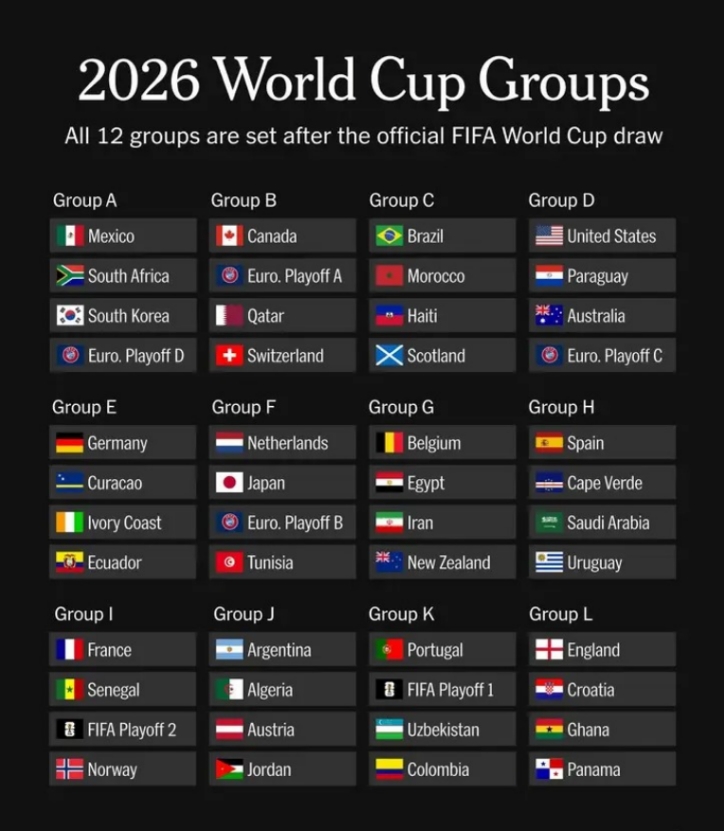
The final draw assigned the 48 qualified teams into 12 groups (Groups A–L), four teams per group. As co-hosts, the Mexico national football team, the Canada national football team, and the United States men’s national soccer team were pre-placed in Groups A, B, and D, respectively.
The 2026 edition is historic: for the first time, the World Cup will be hosted by three countries simultaneously: the United States, Canada, and Mexico. Matches will be spread across 16 cities: 11 in the U.S., 3 in Mexico, and 2 in Canada.
The tournament kicks off 11 June 2026, with the opening match at the legendary Estadio Azteca in Mexico City—Mexico will host that first match as part of Group A.
The final is scheduled for 19 July 2026 at MetLife Stadium in East Rutherford, New Jersey, USA. Group-stage games for each host nation will be played domestically—so Mexico will play all its group games in Mexico, Canada in Canada, and the U.S. across various American venues.
Other host cities in the USA include (but are not limited to) Los Angeles, Dallas, Houston, Atlanta, Miami, the San Francisco Bay Area, Seattle, Kansas City, Philadelphia, Boston, and New York/New Jersey.
With the draw complete, some groups stand out more than others—whether because of drama, history, or potential fireworks on the field. Here are a few of the more interesting ones, based on the grouping shown in your image and media coverage.
Group C—Brazil national football team, Morocco national football team, Scotland national football team, and Haiti national football team. A mix of traditional power (Brazil), rising football nations (Morocco), historical underdogs (Scotland), and relative unknowns (Haiti) could produce surprises, especially with such varied styles and backgrounds.
Group D—Hosts USA along with the Paraguay national football team, the Australia national soccer team, and a yet-to-be-determined European playoff team. For the U.S., this draw may be relatively favorable compared to tougher “groups of death.” The group gives them a mix of challenge and opportunity.
Group L—England national football team, Croatia national football team, Ghana national football team, and Panama national football team. Notably, England vs. Croatia recreates their 2018 semi-final matchup, which adds history and narrative weight. Ghana and Panama add variety—potential for underdog surprises.
Group E—The Germany national football team is joined by the Curaçao national football team, the Ivory Coast national football team, and the Ecuador national football team. Looks like a mix of established European strength with energetic African and South American sides—could be more competitive than some expect.
Group J—Argentina national football team (current champion), plus Algeria national football team, Austria national football team, and Jordan national football team. Argentina’s path begins—but underdogs like Algeria or Austria could make life uncomfortable.
Beyond these, there are more traditional powers scattered across other groups: Spain, France, the Netherlands, Portugal, etc. That ensures that group-stage games will carry real weight, even if there are a few “soft” groups.
Because the tournament is expanded to 48 teams, there are also placeholder slots in some groups—for instance, “European Playoff A/B/C/D” or “FIFA Playoff 1/2”—meaning not all berths are filled yet. That adds an extra layer of unpredictability.
The 2026 World Cup will be the largest ever, with 48 teams—increasing diversity and giving more countries a shot on the world stage. Hosting across three countries—the US, Canada, and Mexico—allows for massive geographic spread, potentially giving many regions first-time exposure to World Cup matches.
Splitting groups and hosts cleverly: each host plays its group games in its own country, which helps with travel logistics and allows local fans to cheer at “home.”
The group draw has created a mixture: “safe” groups where traditional powers dominate, but also “wild card” groups with underdogs and unknowns—which often result in surprises.
That mix tends to make tournaments more exciting. Because of placeholders (playoff winners), there’s still uncertainty in some groups.
Once all qualifying is done (including playoffs), the final identity of all 48 teams and matchups will be locked in.