
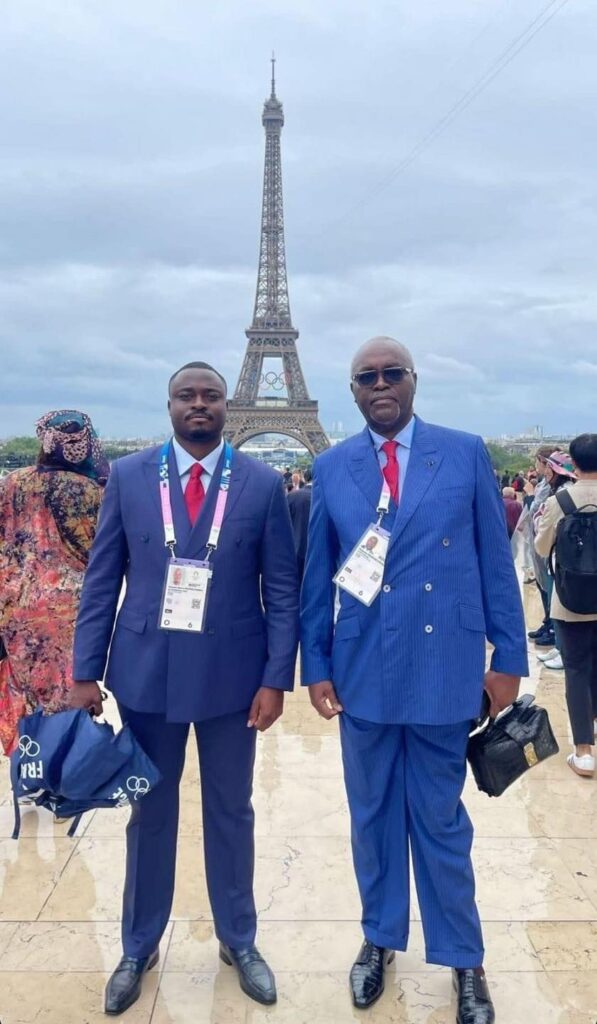
Hugues Ngouélondélé has held important political offices in Congo-Brazzaville for decades. He served as Mayor of Brazzaville (2003–2017) and as a Member of the National Assembly. Since 2017 he has been Minister of Sports.
His family connections are unmistakable: he married a daughter of the longtime ruler Denis Sassou Nguesso. His sister also married into the extended Sassou-Nguesso clan.
Because of these ties, many view him less as a professional sports administrator and more as an extension of the ruling elite—making sports management deeply political, rather than technical.
Those facts on their own don’t prove wrongdoing. But when they combine with a string of administrative failures, institutional interference, and public discontent—things start to look rotten at the core.
The turning point came in late 2024: the leadership of the national football body, FECOFOOT, was forcibly changed. The then-re-elected president of FECOFOOT, Jean‑Guy Blaise Mayolas, and his executive committee were removed by decision of the Ministry of Sports—argued to be for “mismanagement.” The ministry installed an ad hoc committee.
This intervention triggered two major consequences:
Several FECOFOOT offices and facilities were sealed, locked, or occupied by state authorities. The federation lost control over its premises and bank accounts.
On 6 February 2025, FIFA—after missions with CAF—suspended FECOFOOT for “third-party interference,” in violation of FIFA’s statutes requiring autonomy of national federations.
As a result, all Congolese national teams and clubs were barred from international competitions. That included their upcoming 2026 World Cup qualifiers.
The national team missed at least two matches, and forfeits were awarded under FIFA’s disciplinary rules.
Following the suspension, the “official” line from the Ministry was that they would negotiate with FIFA and CAF to lift the ban—but “without compromising principles.”
In other words, they acknowledged the crisis but refused to simply reinstate the ousted leadership. That suggests this was less about fixing problems than about consolidating control.
By mid-May 2025, FIFA lifted the suspension because FECOFOOT regained formal control of its headquarters, technical center, and bank accounts.
Yet reports and former players say nothing really changed in terms of conditions: poor logistics, mismanagement, chaotic convocations, and unprofessional handling of national team affairs.
Thus the “fix” seems cosmetic—institutional autonomy restored on paper, but underlying organizational dysfunction remains.
Media reporting in late 2025 shows that many of the country’s expatriate footballers have refused national-team call-ups. They denounce what they describe as “deplorable working conditions”: late convocations, worn-out equipment, sloppy travel logistics, and lack of basic professionalism.
One midfielder was quoted (in a French-language source) saying that the team often arrives at its hotel hours before a match after a long night flight—”this is not serious.”
In effect, the national team has become a toy in a bigger game of institutional power—and many players don’t want to be part of it anymore.
Loss of legitimacy and opportunities — The 2025 suspension and prior mismanagement deprive youth players and national teams of tournaments, exposure, potential contracts, and development programs. Under-17 teams, clubs, and talented youngsters risk being cut off from a path to international sport.
Erosion of trust—Players abroad feel disrespected by chaotic treatment; many decline call-ups. Without trust, even talent can vanish into club focus.
Political over meritocracy—When leadership is based on family ties or political loyalty rather than competence, sport becomes a vehicle of power, not progress. That risks alienating fans, discouraging reform-minded professionals, and institutionalizing corruption.
International shame & sporting damage — A once-proud national team now bounces between suspensions, forfeits, and disappearance from tournaments. That damages Congo’s reputation and undermines future ambition.
Structural autonomy: FECOFOOT must be allowed to operate independently, with full control over its infrastructure, finances, and staff—without political interference. That means no more ad hoc committees or politically imposed leadership reshuffles.
Transparent governance: Leadership roles and administrative posts should be assigned based on merit, experience, and professionalism—not family loyalty.
Players’ protection mechanisms: There should be an independent body where players can raise grievances about logistics, travel, accommodations, and pay—and get real answers.
Accountability for failures: If budgets, funds, or FIFA-allocated resources are misused—or if organizational negligence harms the sport—there must be real consequences.
Public communication: The authorities must stop dragging football into opaque political deals. Everything from convocations to match planning needs to be coordinated transparently, real early, with respect to players and clubs.
These aren’t cosmetic fixes—they require a shift in how politics, sport, and governance intersect in Congo.
In Congo-Brazzaville, football should be a unifying force, a source of national pride and youth opportunity. Instead, it has become a battleground for political control. Under Hugues Ngouélondélé’s watch—a man deeply embedded in the ruling clan—sports governance has been compromised: institutional interference, FIFA suspension, broken trust with players, and chaos in national team administration.
The recent lifting of the FIFA ban is not a signal everything is okay. It is merely a reset button. Without real structural reform, Congo risks stalling, wasting talent, and becoming a ghost in African football history.
For the sake of the players—and for the fans who still believe—Congo must choose competence over connections.